
From investment to impact: why digital health is now a board obligation
Why governing digital health investment as an operating discipline, rather than as a project, is the essential leverage point for health boards in 2026
Damian Green FAIDH FACHSM GAICD
Download the full report here: From investment to impact: why digital health is now a board obligation (6.7 MB)
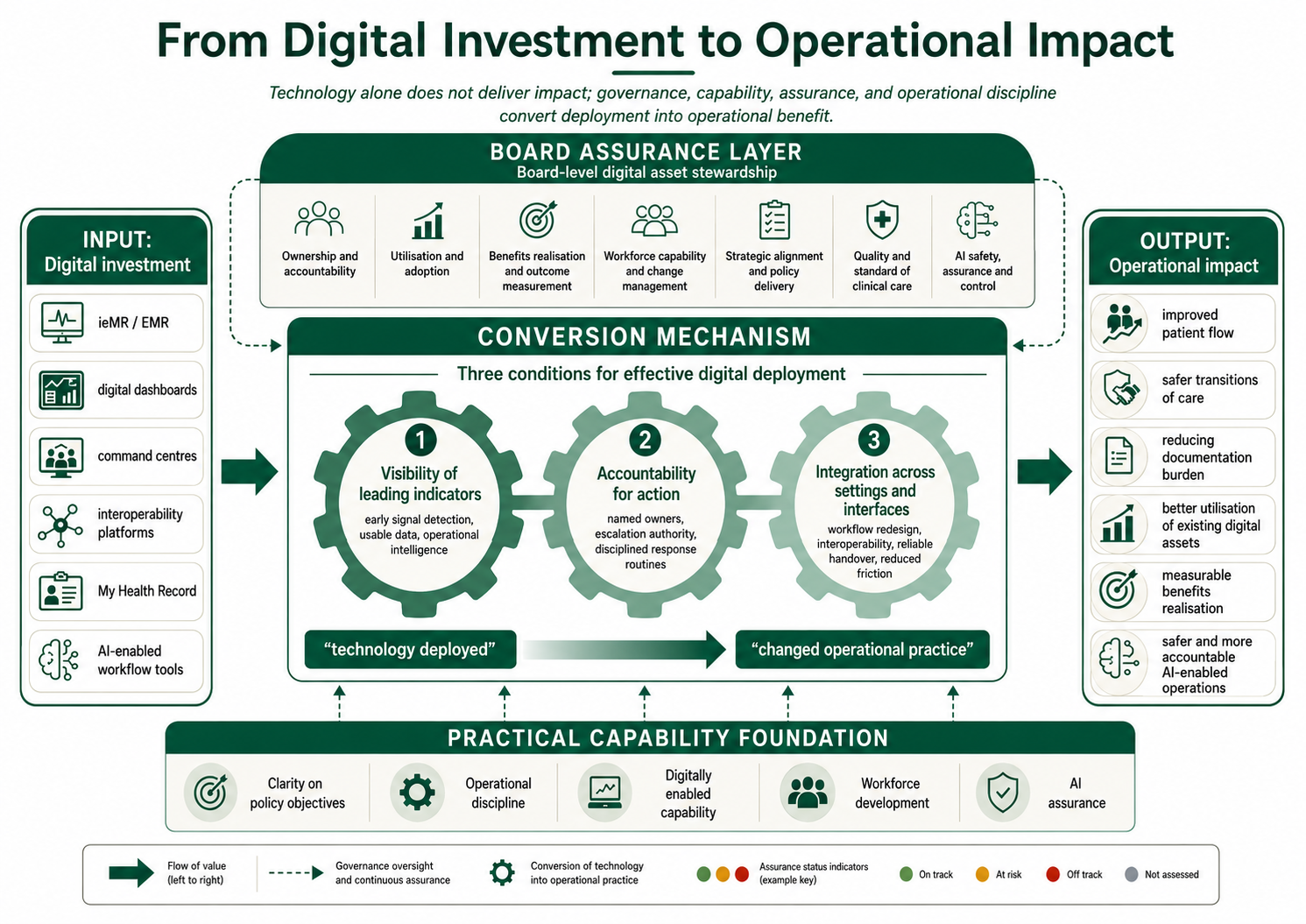
Australia’s health system has invested heavily in digital solutions including integrated EMRs, dashboards, command centres, interoperability platforms and now AI-enabled tools. The operational performance of the health system has not improved at the same pace. Four‑hour emergency department performance has fallen over the past decade, stranded patients occupy thousands of beds, and workforce pressure is intensifying. This is no longer just a technology story; it is a governance story.
Investment to Impact (D. J. Green Advisory Pty Ltd)
The central argument of the report is that digital health and AI must be governed as an operating discipline, not as a sequence of projects. Digital should be treated as core infrastructure that either delivers measurable improvements in access, safety, cost and workforce – or quietly consumes resources and adds friction.
The digital–operations gap
Across Australia, major digital assets are already in the field: Queensland’s integrated EMR program, the NSW Single Digital Patient Record, My Health Record modernisation and interoperability programs among others. Yet many health services still struggle with exit block, delayed discharges and growing documentation burden, even where digital tools are technically deployed.
The evidence suggests the core problem is not primarily that the wrong technology has been purchased. It is that the governance architecture to translate technology into changed practice has not been consistently built or sustained. Too often, the energy and funding stop at go‑live, while benefits realisation, workflow redesign and optimisation are left to already‑stretched line managers
AI is now amplifying this gap. Hospitals are already using AI for documentation, workflow optimisation and predictive analytics, often at pace, and when these tools are added to fragile workflows without strong governance they can increase risk, duplication and clinician burden instead of relieving it.
When digital actually changes performance
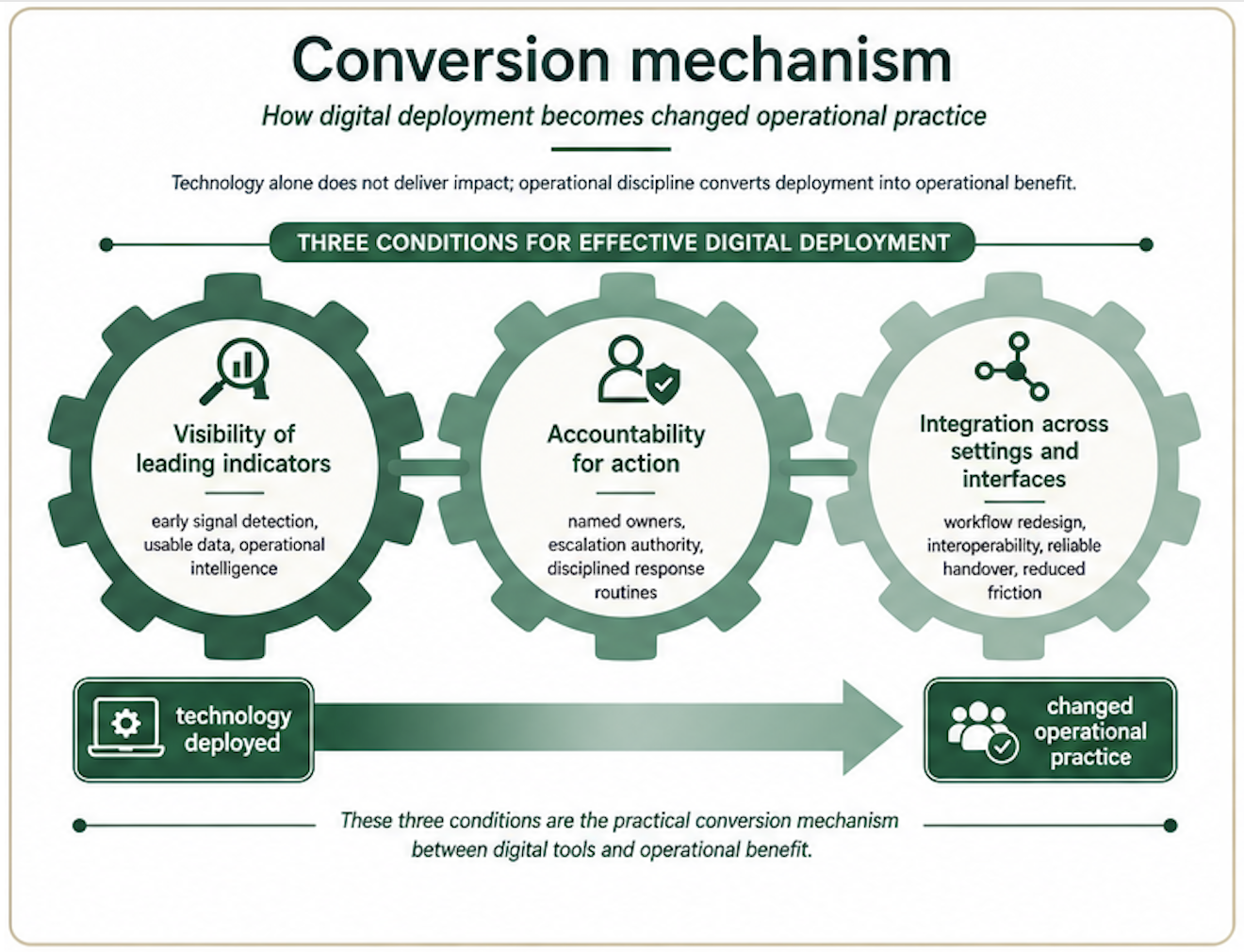
The report argues that digital tools change operational performance only when three frontline conditions are in place: visibility, accountability and integration.
Conversion Mechanisms (D. J. Green Advisory Pty Ltd)
Visibility means that leading indicators, not just lagging metrics, are visible early enough to matter. Command centres, flow dashboards and predictive tools are valuable only when they surface signals before pressure becomes crisis and when someone is responsible for acting on those signals.
Accountability means named owners, escalation rules and standard operating routines that convert information into timely action. Discharging a patient at 10:30 am has a very different operational impact from discharging the same patient at 5:30 pm; governance is what turns that insight into everyday practice.
Integration means digital systems are embedded into real workflows and handovers across hospital, primary care, aged care, disability and community settings – not just technically connected but actually used at the point of care. Australia’s Residential Care Transfer Summary is a practical example: it exists and is funded, but fragmented systems and weak adoption mean the value is still not fully realised.
AI raises the stakes on all three conditions, because predictive models, ambient documentation and workflow automation can reduce decision latency and administrative load, or create new queues of alerts and opaque risk, depending on how they are governed.
Why this is a board problem
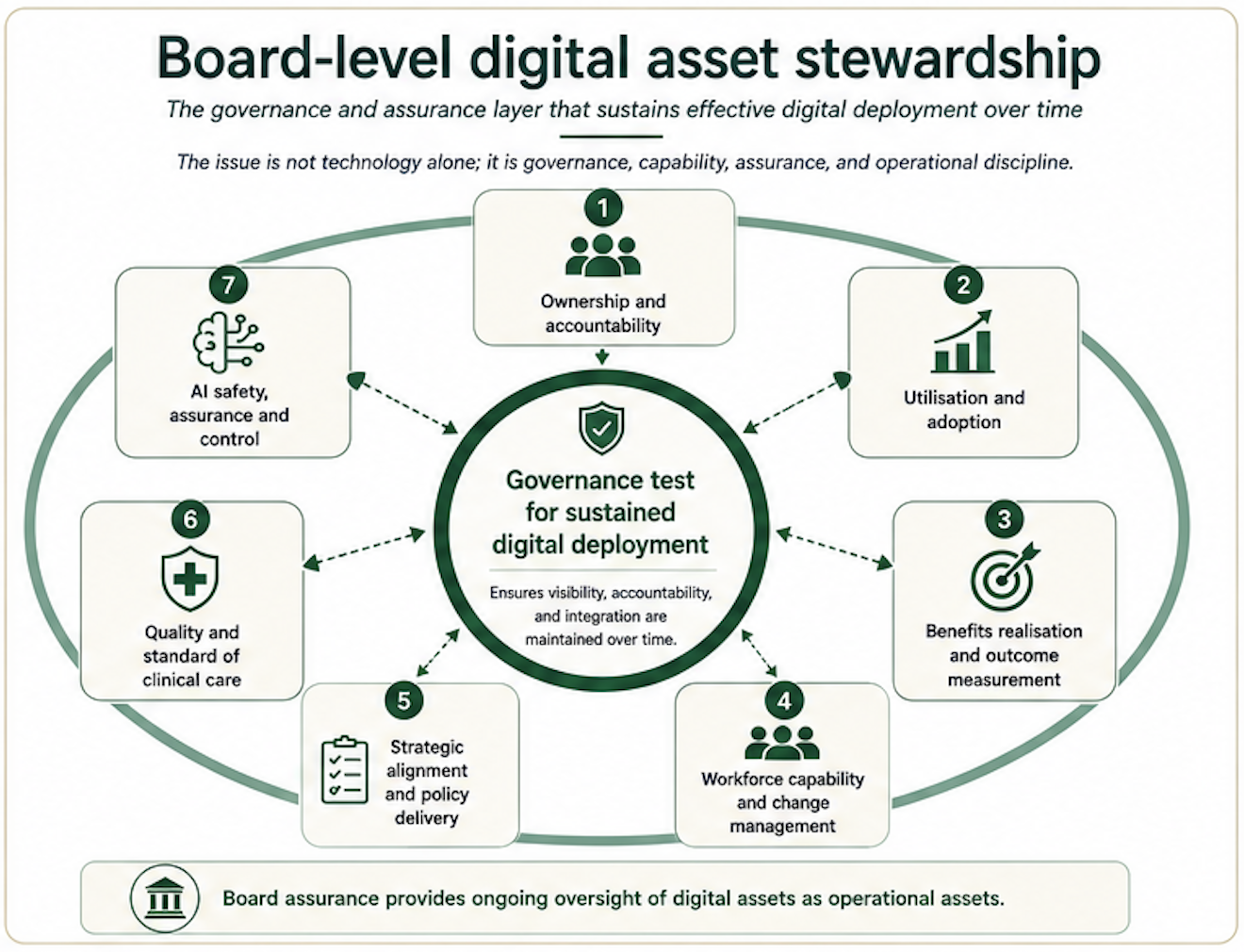
Digital asset stewardship is now a board‑level governance obligation, not just an IT or project management concern. Directors’ duties of care and diligence extend to the way digital systems and AI are used to deliver care, manage risk and steward public resources.
Digital Asset Stewardship Framework (D. J. Green Advisory Pty Ltd)
To make this practical, the report proposes a Digital Asset Stewardship Framework built around seven board‑level domains:
Ownership and accountability: Each material digital or AI investment has a named executive owner for the operational outcome, not just the technology.
Utilisation and adoption: Boards receive regular reporting on active use and workflow integration, not just go‑live status.
Benefits realisation and outcome measurement: Boards can see whether specific operational measures, such as discharge timing, length of stay, documentation burden or handover reliability, are moving in the intended direction.[
Workforce capability and change management: Deployment is matched by investment in workflow redesign, training, AI literacy and post‑go‑live optimisation.
Strategic alignment and policy delivery: Digital investments explicitly support core policy objectives around access, transitions, workforce, cost, quality and equity.
Quality and clinical care: Digital systems and AI‑enabled workflows are subject to the same clinical governance rigour as other care processes, including safety and continuous improvement.
AI safety, assurance and control: AI use cases are inventoried, risk‑classified and subject to proportionate oversight, including performance monitoring, bias, equity and liability considerations.
These domains give boards a way to move beyond project status reports to a structured set of assurance questions about value, risk and workforce impact.
Five capabilities that turn investment into impact
Capability Foundation (D. J. Green Advisory Pty Ltd)
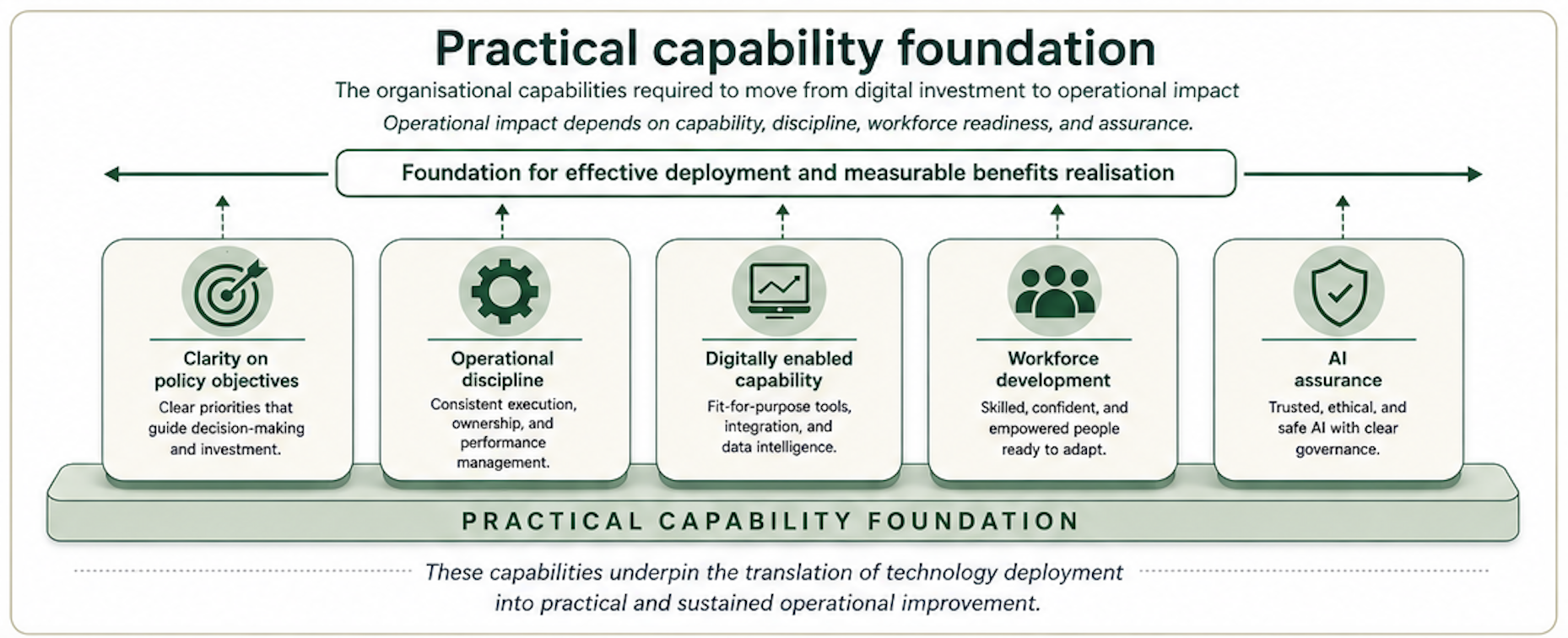
At an organisational level, the report finds that services that consistently convert digital investment into operational improvement tend to combine five capabilities:
Clarity on policy objectives : A precise definition of the operational problems digital investment is meant to solve, such as access block, stranded patients or documentation burden.
Operational discipline: Clear ownership, leading‑indicator monitoring and accountability for action at the frontline.
Digitally enabled operations: Systems designed to reduce friction, accelerate decision‑making and support scope‑of‑practice optimisation rather than just digitising existing paperwork.
Workforce development: Clinical, operational and informatics roles equipped to use digital systems confidently, safely and effectively, with capacity for ongoing redesign.
AI assurance: Explicit controls for higher‑risk AI use cases, including validation, oversight and incident monitoring.
These capabilities can be strengthened using assets that are already deployed. The key question is whether governance, capability and operating discipline are keeping pace with the scale of investment.
A practical invitation to boards
For Australian health boards, digital and AI are now part of the core operating environment, not experimental edge cases. The systems that shape how patients move through hospitals, how clinicians document care and how data informs decisions are now digital and increasingly AI‑enabled.
Boards do not need to design workflows or choose algorithms. They do need to be able to answer some straightforward questions on a regular basis: who owns the outcomes major digital investments were supposed to deliver, whether clinicians and managers are actually using the tools as designed, whether the measures that justified the business case are moving in the right direction, and which AI tools are in use and how they are being overseen.
The full report, From Investment to Impact: The Governance Obligation in Australian Digital Health, sets out the evidence, framework and examples in detail. It is intended as a practical resource for boards, executives and clinical leaders who want to turn existing digital investment – including AI – into safer care, better access and more productive use of scarce workforce.
Download the full report here: From investment to impact: why digital health is now a board obligation (6.7 MB)